
Over 70% of digital transformation projects fail due to misaligned technology decisions.
One of the first and most crucial choices a growing company faces is whether to build custom software or go with an off-the-shelf solution.
While off-the-shelf tools promise quick setup and lower initial costs, custom-built software often leads to greater efficiency, scalability, and long-term ROI. But the answer isn’t always straightforward.
In this guide, we’ll walk you through when to build vs. when to buy, share ROI insights, and help you make a decision that aligns with your business’s growth strategy.
Understanding the Basics
Off-the-Shelf Software refers to pre-built tools made for a wide range of users. Think: Slack for communication, QuickBooks for accounting, or Shopify for e-commerce.Custom Software is built specifically for your business tailored to match your workflows, goals, and customer needs. Whether developed in-house or by tech partners like Iqonic, custom solutions fit like a glove.
Custom Software Offers 35-50% Higher Efficiency Over Time
Off-the-shelf tools may be ready on day one, but they often come with limitations, limited customization, expensive add-ons, and feature overload you’ll never use.
Custom software, while it requires more upfront planning, delivers tailored efficiency that scales with your business. This means fewer workarounds, better team adoption, and higher performance over time.
Let’s break down the decision-making framework.
Decision Framework: Build or Buy?
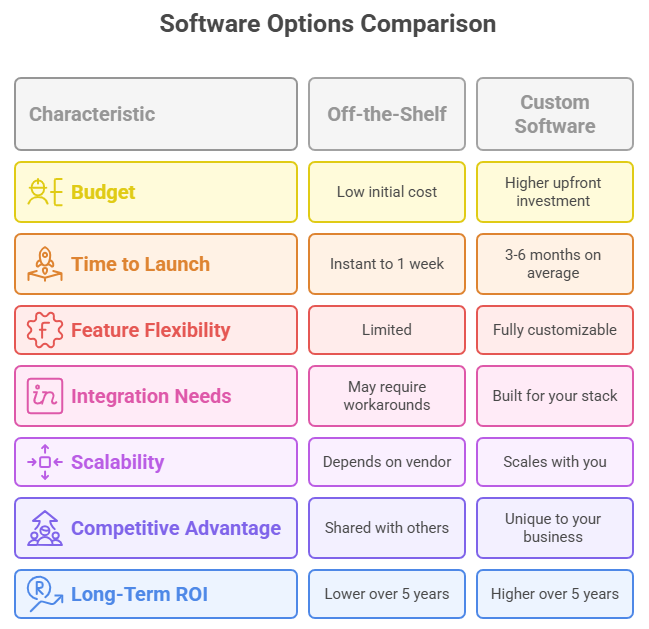
Here’s a practical checklist to help you decide.
Businesses using custom software see 3.5x better ROI after 3 years.
Let’s look at this with an example.
Real-World Scenario: Logistics Startup at a Crossroads
A mid-sized logistics company needed a system to manage fleet tracking, deliveries, and customer support. They are considered a popular SaaS platform. It offered basic tracking, but not:
- Real-time fuel cost tracking
- Automated rerouting
- Regional compliance customization
Building their own platform took 5 months. But within a year, they cut operational costs by 22%, improved delivery times by 18%, and were able to sell their tech stack to partners as a new revenue stream.
Off-the-shelf would’ve been faster, but not transformational.
The Long-Term Cost Equation
Off-the-Shelf:
- License fees
- Hidden costs for additional users
- Feature bloat or missing key functions
- Third-party integration costs
- Upgrade limitations
Custom Software:
- Higher initial investment
- Ongoing maintenance
- Full ownership
- Adaptability to evolving business needs
- Potential to turn tech into an asset
Tip: If you plan to grow or evolve your offering in the next 2–5 years, custom software often pays off faster than expected.
Custom tech becomes an asset. Off-the-shelf remains a liability.
When you own the software, you own the IP, the data, and the innovation. You’re not tied to a third-party roadmap or pricing changes.
In contrast, off-the-shelf vendors can:
- Discontinue features you rely on
- Change pricing without warning
- Limit your data portability
When Buying Off-the-Shelf Makes Sense?
We’re not against off-the-shelf. In fact, it’s perfect when:
- You’re a small startup testing an idea
- Your needs are standard (e.g., basic CRM or payroll)
- Budget is tight and time is critical
- There’s a proven SaaS that covers 90%+ of your needs
Off-the-shelf is often ideal as a bridge solution—something to get you moving while your business model stabilizes.
When to Invest in Custom Software?
You should seriously consider going custom if:
- You have unique business processes
- Your team spends hours on repetitive manual tasks
- You’re scaling fast or across regions
- You need tight integration with existing systems
- You want to future-proof your tech
- You want to build IP or explore product licensing
The Hybrid Approach: Best of Both Worlds
More businesses are blending both options. For instance:
- Start with a SaaS platform.
- Build APIs or add-ons to customize the experience.
- Gradually phase in custom modules as the business grows.
This approach reduces risk while maximizing flexibility.
Building Custom Software with the Right Partner
If you’re leaning toward custom, the biggest factor is your development partner.
At Iqonic, we help brands build scalable, secure, and future-ready custom software solutions. From MVPs to enterprise-level systems, our approach is collaborative, fast-paced, and ROI-driven.
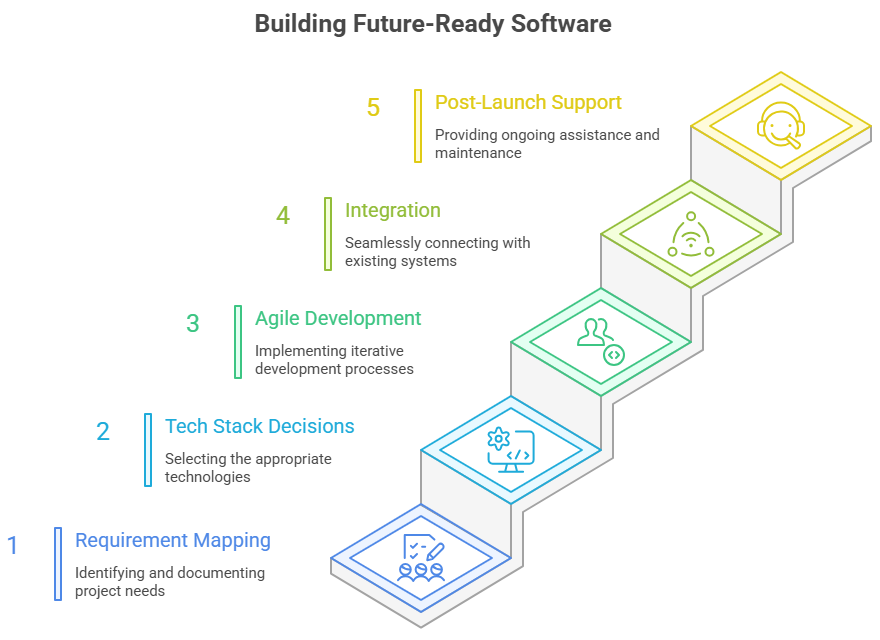
Our team handles:
- Requirement mapping
- Tech stack decisions
- Agile development
- Integration with your current tools
- Post-launch support
Final Thoughts: Invest in What Grows with You
Technology is no longer just a tool, it’s a strategic advantage. Choosing between custom software and off-the-shelf solutions is more than a tech decision; it’s a business-defining move.
If your goal is quick setup and basic functionality, off-the-shelf may serve you well. But if you’re aiming for long-term growth, seamless operations, and a competitive edge, custom software is not just an investment it’s a foundation.
Great businesses don’t adapt to software. They build software that adapts to them. Choose the path that aligns with your vision not just for today, but for where you want to be in the next 5 years.