
Introduction
Consider building custom software like planning a major construction project. You wouldn’t begin without understanding the financial requirements, timeline implications, and resource allocation needed for success. The same principle applies to custom software development. Understanding costs upfront enables informed decisions that align with business objectives and financial constraints.
Custom software project costs typically range from $50,000 for basic applications to over $500,000 for complex enterprise systems. This significant variance underscores why accurate cost estimation is critical for project success.
This guide provides seven practical steps for estimating software development costs with accuracy. You’ll understand the key cost drivers, learn to identify hidden expenses, and develop budgets that account for both initial launch and long-term operational costs.
Why Accurate Software Cost Estimation Matters
Before diving into cost factors and estimation methods, understand why getting this right matters. Poor estimation doesn’t just mean spreadsheet errors; it means failed projects, burned teams, and wasted investments. With 66% of software projects exceeding budgets, accurate estimation is your competitive advantage.
Prevent Budget Overruns
Software project budget overruns represent one of the most common challenges in software development. Research from McKinsey & Company indicates that approximately 66% of software projects exceed their initial budgets or miss deadlines, primarily due to unclear requirements, unexpected technical challenges, or underestimated project complexity.
Accurate cost estimation provides the financial clarity needed for informed decision-making. When stakeholders understand that adding a specific feature will require an additional $30,000 and extend the timeline by three weeks, they can make objective decisions about necessity and priority.
Reduce Project Delays
Financial planning and timeline management are intrinsically connected. Accurate cost estimation includes realistic time allocation and identification of potential bottlenecks before they impact delivery schedules.
Here’s what actually happens with bad estimates: Your team doesn’t have enough money or time to do the job right. So they’re stuck working crazy hours, cutting corners just to keep up. Developers get exhausted. They start making mistakes because they’re rushing. Those mistakes create bigger problems that take even more time to fix. Before you know it, your three-month project is now six months behind, and everyone’s frustrated.
Proper financial planning ensures adequate resources for each development phase. Teams have appropriate time for implementation, testing occurs thoroughly, and launches happen on schedule because the foundation was built correctly from the start.
Align Business Goals with Technology Investment
Successful software projects begin with clear business objectives before diving into technical specifications. The cost estimation process requires stakeholders to address fundamental questions: Does this architectural approach deliver sufficient value to justify its cost, or would a simpler solution achieve the same business outcomes more efficiently?
Understanding the true cost of different approaches naturally guides teams toward cost-effective solutions. For example, analysis might reveal that a hybrid mobile application meets 95% of requirements at 40% of the cost of developing separate native iOS and Android applications.
Key Factors That Influence Software Development Costs
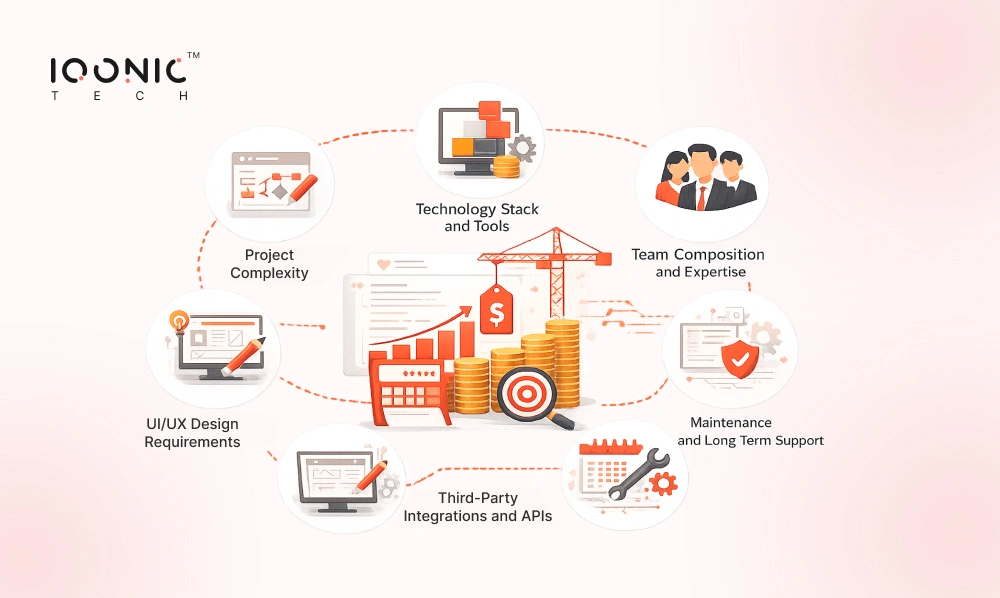
Not all software costs the same. A basic app might cost $50,000 while an enterprise platform exceeds $500,000. What drives this 10x variance? Six key factors determine your final bill, with project complexity and team composition dominating. Understanding these drivers transforms estimation from guesswork to science.
Project Complexity
Software complexity is the primary cost driver in any development project. A straightforward application with basic functionality might require a small team working for several weeks. An enterprise platform with sophisticated workflows, multiple user roles, and complex business logic could require months of development from a larger, more specialized team.
Consider a task management application as an example. A basic version allows users to create tasks and mark them complete. But the moment you add real-time collaboration, granular permissions, automated workflows, calendar sync , and advanced reporting dashboards, the scope expands significantly- bringing higher mobile app development efforts, longer timelines, and increased costs.Suddenly you’re building something ten times more complex. And complex means expensive. What might’ve cost $50,000 as a basic app can easily hit $500,000 with all those features.
Technology Stack and Tools
The selection of programming languages, frameworks, and platforms significantly impacts both development and operational costs. Some technologies require specialized expertise that commands premium rates, while others benefit from large developer communities and competitive pricing.
Modern frameworks can accelerate development timelines, though they may require licensing fees or additional training investment. Infrastructure considerations-cloud hosting, testing tools, monitoring services, and development environments, add substantial ongoing costs that must be factored into the total cost of ownership.
Team Composition and Expertise
WHERE YOUR BUDGET ACTUALLY GOES:
Team Salaries: 60-80%
Design & UX: 10-20%
Integrations/Tools: 5-10%
Testing & QA: Already in team costs
Project Management: Already in team costs
According to Stack Overflow’s 2024 Developer Survey and Clutch.co’s 2024 pricing reports, hourly rates vary significantly by geography:
- North American developers: $100-250 per hour
- Eastern European developers: $40-80 per hour
- Asian developers: $25-50 per hour
This represents up to a 10x variance based on location, though distributed teams may introduce communication and coordination challenges that offset some cost savings.
UI/UX Design Requirements
Quality design is a critical investment, not an optional expense. Intuitive, well-designed interfaces directly determine user adoption and satisfaction rates.
Research from the Nielsen Norman Group demonstrates that every dollar invested in UX/UI design returns approximately $100 in value, a 10,000% ROI. Professional design work encompasses user research, information architecture, wireframing, visual design, prototyping, and usability testing. Plan to allocate 10-20% of the total budget for design activities.
Quality design also reduces overall development costs by identifying and resolving usability issues early in the process, when changes are least expensive to implement.
Third-Party Integrations and APIs
Modern software applications typically integrate with multiple external services: payment processors, email platforms, cloud storage providers, analytics tools, and CRM systems. Each integration adds both development time and ongoing operational costs.
While some integrations are relatively straightforward, others consume significantly more development resources than initially anticipated. Additionally, most services charge recurring fees. Payment processors typically charge 2.9% plus $0.30 per transaction, email services bill based on volume, and cloud providers charge for storage and bandwidth. These operational costs commonly add 15-30% to the total budget over three years.
Maintenance and Long-Term Support
Software launch represents the beginning of the lifecycle, not the conclusion. Post-launch software requires ongoing maintenance, including bug fixes, security patches, performance optimization, and compatibility updates as operating systems and browsers evolve.
According to IEEE Software Engineering Standards, organizations should budget 15-25% of initial development costs annually for maintenance. For a $200,000 development project, this translates to $30,000-50,000 in annual maintenance expenses to ensure continued operation and security.
How to Approach Estimating Custom Software Development Costs
Understanding cost drivers is the foundation; applying systematic methodology creates accurate estimates. The difference between rough approximation and reliable budgeting lies in how thorough your approach is.
Understanding Your Business Goals
Before estimating costs, establish clear success criteria. Are you reducing operational costs by 30%? Improving customer retention metrics? Enabling entry into a new market segment?
Business objectives serve as the decision-making framework throughout the project. When evaluating technical recommendations, clear objectives help you assess whether proposed solutions genuinely advance business goals or simply add complexity without commensurate value.
Breaking Down the Project into Features and Modules
Accurate estimation requires granular analysis. Rather than estimating “user management” as a single item, decompose it into constituent parts: registration, authentication, password reset, profile management, and permission systems.
This modular approach reveals hidden complexity and identifies features that appear simple but require substantial development effort. It also facilitates more accurate time and resource allocation for each component.
Evaluate Technology Options
Technology selection extends beyond choosing the latest framework. Consider developer availability in the marketplace, long-term platform support, licensing costs, scalability characteristics, and total cost of ownership.
A newer framework requiring specialized developers at $200 per hour may ultimately cost significantly more than a proven technology stack with abundant developer availability at $80 per hour. The optimal choice balances technical requirements with practical considerations of cost, maintainability, and long-term viability.
Determine Team Requirements
Identify required roles and time allocation for each team member. A senior full-stack developer at $150 per hour who completes work in two weeks often represents better value than three junior developers at $60 per hour each, requiring a full month to achieve the same outcome.
The right team composition can reduce total project costs by 30-40% while simultaneously improving code quality and reducing technical debt.
Considering Design, Testing, and Quality Assurance
Design and testing are not optional elements to be added if budget permits, they are fundamental components of successful software development.
Allocate 10-20% of the total budget for design activities and approximately 25% of development time for comprehensive testing. These investments prevent costly post-launch fixes and ensure users can effectively accomplish their intended tasks.
Account for Integration, Licensing, and Subscription Costs
Create a comprehensive inventory of all third-party services required. A payment gateway integration might cost $5,000 upfront plus 2.9% of every transaction indefinitely. Cloud hosting typically starts at $200 monthly but scales with usage.
These recurring costs compound over time. Calculate projected expenses over a 3-5 year period to understand the full financial commitment.
Planning for Maintenance, Updates, and Scaling
Budget 15-25% of initial development costs annually for basic maintenance, security patches, bug fixes, and compatibility updates. Organizations planning to actively evolve their software with new features should budget an additional 20-40% annually.
Over five years, maintenance and enhancement costs often equal or exceed the initial development investment. This ongoing requirement must be factored into total cost of ownership calculations.
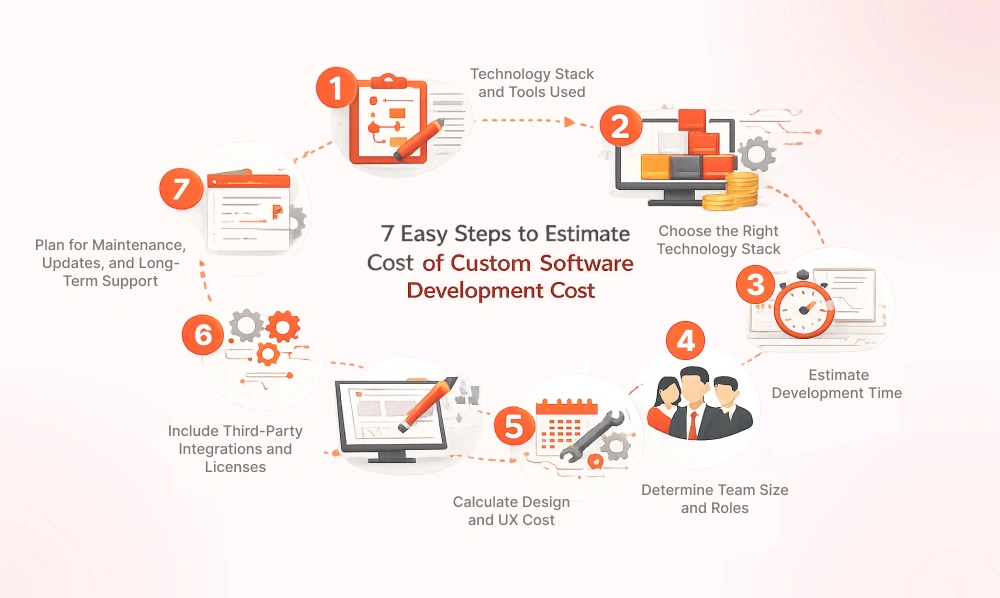
7 Steps to Estimate Custom Software Development Costs

Ready to build your budget? This systematic framework breaks estimation into seven manageable steps. From defining crystal-clear requirements to planning 5-year maintenance costs, each step includes real numbers, practical examples, and proven techniques used by successful projects worldwide.
Step 1: Define Project Scope with Precision
Every successful project begins with a clear scope definition. Vague requirements like “user-friendly platform” lead directly to budget overruns and missed deadlines.
Document every required feature with specificity. Rather than “user management,” specify: user registration with email verification, secure authentication, password reset functionality, profile editing capabilities, and role-based permissions for three distinct user types.
Apply the MoSCoW Method for prioritization:
- Must have: Cannot launch without this functionality
- Should have: Important but not critical for initial launch
- Could have: Provides value but can be deferred
- Won’t have: Explicitly excluded from this version
Be rigorous in applying these criteria. When stakeholders advocate for their preferred features, ask: “Can we launch and deliver core value without this capability?” If the answer is yes, it does not qualify as a must-have.
Step 2: Choose the Right Technology Stack
Technology stack selection affects development costs, maintenance expenses, scalability potential, and the ease of finding qualified developers. Make strategic choices based on project requirements rather than current trends.
For web applications, proven technology combinations typically offer the best balance of capability and cost-effectiveness: React or Vue.js for frontend development, Node.js or Python for backend services, and PostgreSQL or MongoDB for data persistence. For mobile applications, evaluate whether native development (optimal performance) or cross-platform frameworks like React Native (single codebase, 30-40% cost reduction) better serve your requirements.
Consider long-term implications:
- Calculate the total cost of ownership over 3-5 years, not just the initial development
- Assess whether the technology stack scales appropriately as the user base grows
- Evaluate developer availability for future hiring and maintenance needs
Step 3: Estimate Development Time
Break the project into specific tasks and estimate hours for each component. Your timeline should reflect realistic assessment, not aspirational goals.
For each feature, identify the actual work required. “User authentication” encompasses multiple tasks:
- Database schema design: 8 hours
- Registration API development: 12 hours
- Email verification system: 10 hours
- Login functionality: 10 hours
- Password reset workflow: 8 hours
- Frontend form implementation: 14 hours
- Comprehensive testing: 16 hours
- Total: 78 hours
Include a 20-30% contingency buffer for unexpected challenges. This is not padding, it acknowledges that software development inherently involves problem-solving and occasionally encountering unforeseen technical obstacles.
Sample Timeline Structure:
- Feature development: 800 hours
- Testing (25% of development): 200 hours
- Subtotal: 1,000 hours
- Risk contingency (25%): 250 hours
- Total estimated: 1,250 hours
Step 4: Determine Team Size and Roles
Identify required roles and time allocation for each team member. Personnel costs typically represent 60-80% of the total project budget.
Standard team composition includes:
- Project Manager (10-15% of total project time)
- Backend Developers
- Frontend Developers
- UI/UX Designer
- Quality Assurance Engineers (20-25% of developer time)
Simple projects typically require 2-4 team members. Medium complexity projects function effectively with 5-8 people. Large enterprise initiatives may require 10-15 specialists.
Location Rate Comparison:

Recommended Hybrid Strategy:
- Keep onshore: Project Manager, Lead Designer, Solution Architect
- Utilize offshore: Backend/Frontend developers, QA engineers
- Result: Combines cost efficiency with effective communication and coordination
Step 5: Calculate Design and UX Cost
Quality design directly impacts user adoption and satisfaction. Allocate 10-20% of the total budget for comprehensive design activities.

Total Design Investment is $26,600. Include a budget for usability testing with 5-8 representative users. Observe how they interact with prototypes, identify points of confusion, and refine the design based on feedback. This investment in quality design reduces development rework and accelerates user adoption after launch.
Step 6: Include Third-Party Integrations and Licenses
Create a comprehensive list of every external service your software requires. Each service has both integration development costs and ongoing subscription fees.
Common Integration Costs:

A robust application can easily rack up $500-2,000 per month in service fees. Over three years, that’s $18,000-72,000 on top of development costs.
A fully-featured application commonly incurs $500-2,000 monthly in service fees. Over three years, this represents $18,000-72,000 in addition to development costs.
Step 7: Plan for Maintenance, Updates, and Long-Term Support
Software requires ongoing investment after launch to maintain security, compatibility, and performance.
Budget 15-20% of initial development costs annually for basic maintenance, security patches, bug fixes, compatibility updates, and performance optimization. For a $200,000 development project, plan for $30,000-40,000 in annual maintenance expenses.
Most successful software products continue evolving with new features and capabilities. This typically requires an additional 20-40% of initial development costs per year.
5-Year Total Cost of Ownership:
- Year 0 (Initial Development): $200,000
- Year 1 (Maintenance 20% + Enhancements 30%): $100,000
- Year 2 (Maintenance 20% + Enhancements 25%): $90,000
- Year 3 (Maintenance 20% + Enhancements 20%): $80,000
- Year 4 (Maintenance 20% + Enhancements 15%): $70,000
- Year 5 (Maintenance 20% + Enhancements 10%): $60,000
- Total 5-Year Investment: $600,000
Tools and Methods to Estimate Custom Software Cost
Accurate software cost estimation requires combining multiple methods. Understanding different estimation techniques and when to apply each transforms budgeting from guesswork into a predictable process.
Top-Down vs Bottom-Up Estimation
Top-Down Estimation starts with the overall project scope and works backward using historical data and industry benchmarks. Best for early project phases and initial feasibility assessments. Fast but less accurate for unique projects.
Bottom-Up Estimation begins with individual tasks, estimating each component separately before aggregating totals. Most accurate when requirements are clear. For example, estimating “User Authentication” includes database design (8 hours), API development (12 hours), email verification (10 hours), and testing (16 hours).
Best Practice: Use top-down for initial estimates, then validate with a detailed bottom-up analysis once requirements are defined.
Using Software Estimation Calculators
Online cost calculators like Clutch.co and GoodFirms provide quick preliminary estimates based on project type, features, and team location. They’re useful for initial budget ranges and sanity-checking detailed estimates.
Limitations: Calculators use generic assumptions and can’t account for project-specific complexity or existing technical infrastructure.
Recommended Approach: Use multiple calculators for initial ranges, apply top-down estimation for context, then conduct detailed bottom-up analysis for accurate execution planning. Add 25-30% contingency regardless of the method used.
Strategies to Reduce Costs While Maintaining Quality
Lowering software development costs doesn’t mean compromising on quality. With the right approach, businesses can deliver reliable, high-performing software while staying on budget. By validating ideas early, prioritizing high-impact features, and making smart resourcing and contract decisions, you can eliminate waste, maximize value, and build quality products efficiently.
Start with a Minimum Viable Product (MVP)
Build only what is essential to validate your concept with real users. Launching with 12 must-have features instead of 35 planned features can save $100,000+ and reduce time-to-market by 4-6 months.
After launch, allow actual user feedback and usage data to guide feature prioritization. This approach prevents investing resources in capabilities that users don’t value or use.
Prioritize Features Rigorously
Every proposed feature should satisfy these criteria:
- Does it directly serve our core business objective?
- Will users immediately notice if it’s missing at launch?
- Can we add it post-launch based on user feedback?
If the answer to question 3 is yes, defer the feature. This single discipline delivers more cost savings than any other approach.
Implement Strategic Outsourcing
A hybrid staffing model typically provides optimal results:
Keep onshore:
- Product strategy and roadmap decisions
- Design leadership and UX direction
- System architecture and technical leadership
Utilize offshore resources:
- Feature implementation and development
- Quality assurance and testing
- Routine maintenance and updates
This model maintains control over critical decisions and communication while capturing 30-50% cost savings on implementation work.
Consider Contract Structure
Fixed-price contracts work best when:
- Requirements are completely defined and stable
- The scope is unlikely to change during development
- You need budget certainty
Time-and-materials contracts are preferable when:
- Requirements will evolve based on learning
- You need flexibility to adjust priorities
- You’re building something innovative without perfect clarity upfront
Most projects benefit from a hybrid approach: fixed price for well-defined components, time-and-materials for areas requiring exploration and iteration.
Common Estimation Mistakes to Avoid
Insufficient Contingency: Always include a 20-30% buffer for unexpected challenges. Projects without contingency budgets consistently exceed their estimates.
Neglecting Maintenance Costs: Budget 15-25% of development costs annually for ongoing maintenance. This is not optional, it’s the cost of keeping your software operational and secure.
Vague Requirements: Ambiguous requirements make accurate estimation impossible. Invest time upfront to document specific, measurable requirements.
Underinvesting in Design: Allocate 10-20% of the budget for quality design work. The alternative is poor user adoption and costly redesign later.
No Change Control Process: Establish a formal process for evaluating and approving scope changes. “Small additions” without proper evaluation commonly lead to 100-200% budget overruns.
Inadequate Testing Budget: Comprehensive testing requires approximately 25% of development time. Reducing testing to save money inevitably results in more expensive post-launch defect remediation.
Optimistic Bias: Use realistic estimates based on historical data and experience, not best-case scenarios. Best-case estimates are consistently wrong.
Ignoring Compliance Requirements: Regulatory compliance (GDPR, HIPAA, SOC 2, etc.) adds 15-30% to development costs. Factor these requirements into initial estimates.
Conclusion
You now have everything you need to estimate software costs accurately. Put this seven-step framework into action:
Implementation Checklist:
✓ Define scope – Document detailed requirements with stakeholders
✓ Build your budget – Follow the comprehensive seven-step framework
✓ Add contingency – Include 25-30% buffer for risks and unknowns
✓ Think long-term – Calculate 3-5 year total cost of ownership
✓ Get validation – Review with experienced developers or advisors
✓ Control changes – Establish formal change management processes
✓ Plan maintenance – Budget 15-25% annually for ongoing support
With proper planning, realistic expectations, and disciplined execution, your software project can deliver real business value within budget with no surprises, no overruns.
FAQs
1. Why is estimating custom software development cost important?
Estimating costs upfront helps prevent budget overruns, ensures projects stay on schedule, and aligns your team on priorities. It also helps you make smart trade-offs between features, timelines, and technology choices.
2. What factors influence the cost of a custom software project?
The cost of custom software depends on factors like project complexity, number of features, technology choices, team expertise, design and UX needs, integrations, and ongoing maintenance.
3. What costs should I include for design, UX, and testing?
Budget 10–20% of your total project cost for design (user research, wireframes, visual design, prototyping) and around 25% of development time for testing/QA. This ensures software is intuitive, user-friendly, and stable.
4. How do team size and developer roles affect software project costs?
Larger teams or senior specialists cost more per hour, but may complete tasks faster. The right mix of roles-project manager, frontend/backend developers, UI/UX designers, QA can optimize cost, quality, and delivery time.
5. What methods can I use to accurately estimate custom software costs?
To estimate custom software costs accurately, you can break the project into features or modules and calculate the time and resources needed for each. Consider your technology choices, team rates, third-party services, and add a buffer for unknowns. Using cost calculators for quick estimates alongside manual, detailed planning often gives the most reliable results.
6. When should a business use a cost calculator versus manual estimation?
Cost calculators are useful for quick ballpark estimates or comparing scenarios, especially when you need an overview fast. Manual estimation, on the other hand, works best for detailed projects, complex workflows, or when planning budgets for multi-year development. Combining both approaches often gives the most accurate results.