
Introduction to AI Budgeting Tools for Software Projects
AI budgeting tools use pattern recognition to estimate project costs. They learn from thousands of completed projects using machine learning algorithms.
What Are AI Budgeting Tools and How Do They Work?
AI budgeting tools are software cost calculators that use machine learning and pattern recognition to estimate project costs. They apply statistical modelling by learning from thousands of completed projects.
Here’s the difference:
Traditional approach: “This will cost $120,000 based on my experience.”
AI approach: “Based on 15,000 similar projects, the cost range is $115,000-$135,000. We’re 87% confident in this estimate.”
The key difference? AI tools show probability ranges instead of single numbers. This makes uncertainty clear from the start.
Definition and Core Functions
AI budgeting tools analyze thousands of past projects, current market rates, and your unique needs to deliver precise custom software project cost estimates instantly.
Core functions:
- Estimate costs with confidence intervals
- Predict timelines with probability ranges
- Optimize resource allocation across team roles
- Identify and quantify risk factors
- Model scenario variations (MVP vs. full build, different tech stacks)
- Track actual progress against initial predictions
How AI Processes Data for Accurate Predictions
Modern AI systems train on 5,000 to 50,000+ completed projects, using data from GitHub, LinkedIn salary data, and Glassdoor industry reports.
The prediction process:
- Parse requirements into standard categories
- Match features to similar past projects
- Calculate complexity scores for each component
- Estimate effort using weighted historical averages
- Apply current market rates for your location
- Add contingency buffers based on risk factors
- Generate probability distribution across cost ranges
- Present results with confidence intervals
Example: You need a mobile app with authentication, social features, payments, and notifications. The AI finds 847 similar projects. It calculates 680 development hours. It notes that payment plus social features add 12-18% complexity. Final prediction: $68,000-$82,000 with 75% confidence over 14-18 weeks.
Difference Between Traditional Budgeting and AI Budgeting
Traditional estimation has real problems:
- Limited sample size (30-150 projects per estimator)
- Optimism bias and anchoring effects
- No quantified uncertainty ranges
- Time-intensive process (20-40 hours per estimate)
AI advantages:
- Trained on thousands of projects
- No human cognitive biases
- Explicit confidence intervals
- Generates estimates in hours
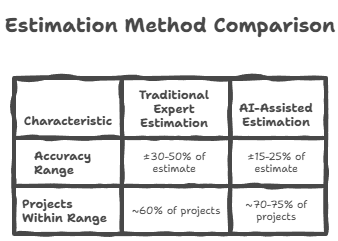
Accuracy comparison (Gartner, 2023):
Benefits of Using AI Budgeting Tools in Software Development
AI budgeting tools deliver measurable improvements across the board.
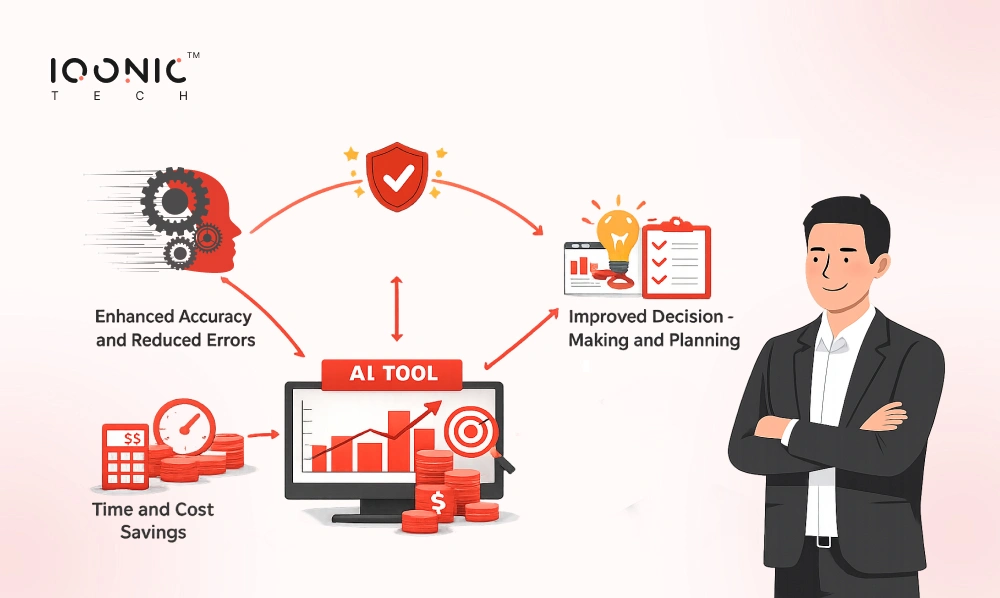
Enhanced Accuracy and Reduced Errors
AI uses pattern recognition at scale. This improves prediction accuracy significantly.
Quantified improvements (Forrester Research, 2024):
- Median accuracy of ± 20% vs ± 35% for traditional methods
- 70-75% of projects finish within the predicted range versus 55-65%
- About 2x reduction in software project budget overruns
Where AI reduces errors:
Feature complexity: AI knows features vary in effort. For example, user authentication can take 12–85 hours depending on complexity, based on 1,000+ real projects
Integration complexity: AI accounts for integration difficulty. Legacy SOAP APIs take 2–2.5× more effort than REST APIs.
Real example: A financial services customer portal needed estimates.
- Traditional estimate: 6 months, $180K
- AI estimate:7–9 months, $210K–$260K (median $235K)
- Actual result: 8.5 months, $242K
Result: AI was 3% off, traditional estimate 34% off – saving $62K.
Important limitation: AI accuracy depends on training data relevance. Novel technologies or unique organizational contexts reduce prediction accuracy.
Time and Cost Savings
AI dramatically cuts estimation time
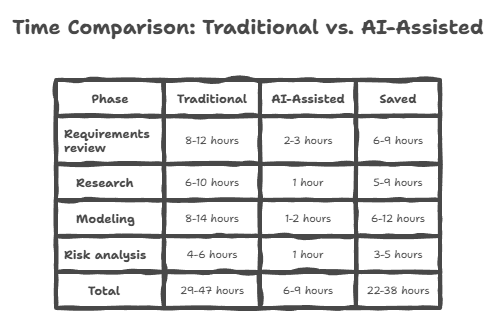
For agencies producing 15-25 estimates yearly: 330-950 hours saved = $33,000-$95,000 at $100/hour.
AI Tool ROI Analysis Item
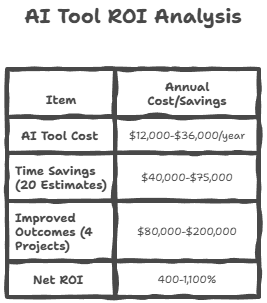
Estimated Annual Return on Investment for AI Tool Implementation
Improved Decision-Making and Planning
AI quantifies trade-offs between different approaches. According to MIT Sloan research, using data-driven project decisions can reduce scope creep by 41% and increase stakeholder satisfaction by 33%.
Strategic decisions AI supports:
- Build vs. Buy: Total cost of ownership modeling over 3-5 years
- MVP vs. Full Build: Identifies highest-value feature sets (20-30% of features drive 70-80% of value)
- Technology stack: Compares long-term implications
- Team composition: Suggests optimal skill mix for 20-25% savings
- Timeline trade-offs: Models accelerated, standard, and budget approaches
Reported outcomes:
- 47% improved project decisions
- 39% had fewer mid-project changes
- 34% improved resource utilization
Key Use Cases of AI Budgeting Tools in Software Projects
AI budgeting tools serve multiple purposes across the project lifecycle.
Improved Decision-Making and Planning
AI cost estimation excels at:
- Estimating new projects during sales/planning phases
- Evaluating vendor bids against market benchmarks
- Planning annual technology budgets
- Modeling cost implications of scope variations
Best for: Projects similar to historical training data with standard technology stacks.
Less suited for: Highly novel projects or cutting-edge technologies with limited track records.
Scenario-Based Budget Planning
AI enables rapid comparison of options:
- MVP or complete product
- Different technology stacks
- Build internally or outsource
- Timeline variations
AI generates comparisons in 15-30 minutes versus 8-12 hours manually.
Risk Management and Anomaly Detection
AI continuously monitors for problems:
- Budget variance
- Scope creep detection
- Resource utilization anomalies
- Timeline slip prediction
Early warnings in week 4 versus week 12 can save $30,000-$60,000 in remediation costs.
Top Features to Look for in AI Budgeting Tools
Not all AI budgeting tools are created equal. Here’s what matters most.
Machine Learning Algorithms
Strong AI capabilities depend on:
- Continuous learning: The system improves with your completed projects
- Adaptation: Customizes predictions based on your team’s performance
- Pattern recognition: Identifies non-linear relationships
- Confidence scoring: Explicit uncertainty quantification
- Transparency: Explains key factors driving predictions
Questions to ask vendors:
- What’s your dataset size?
- How often do you update?
- Can it learn from my projects?
- Do you provide confidence intervals?
- What are your historical accuracy rates?
Integration with Project Management Tools
Your AI tool should integrate with:
- Jira, Asana, Monday.com
- Time tracking tools
- Version control systems
- Finance/ERP platforms
This reduces manual data entry and enables real-time tracking.
Real-Time Forecasting and Updates
Good AI tools provide:
- Live budget tracking
- Automatic forecast updates when project scope changes
- Alerts for cost differences
- Continuous risk assessment
- Updates at every milestone
How to Choose the Right AI Budgeting Tool for Your Business
Choosing the right AI budgeting tool requires examining capabilities and pricing.
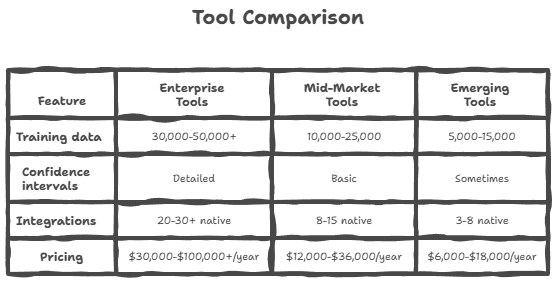
AI Budgeting Tool Comparison: Features and Pricing Across Market Segments
Assessment Criteria
Accuracy & Reliability:
- Training dataset size
- Model update frequency
- Customization options
- Confidence intervals
Ease of Use:
- Intuitive interfaces
- Fast estimate generation
- Clear outputs
Integration & Scalability:
- Compatibility with current tools
- Volume handling
- Multi-project support
Pricing Models
Common models include:
- Per-user subscription ($100-$400/user/month)
- Per-estimate pricing ($500-$2,000)
- Annual flat fee ($12,000-$50,000/year)
- Tiered usage
Consider hidden costs:
- Integration setup
- Training
- Customization
- Data migration
Most organizations achieve positive ROI after 3-5 estimates.
When AI Budgeting Tools Have Limitations
Being aware of what they can’t handle ensures you pick the right tool.
AI accuracy declines for:
- Novel technologies (introduced in the last 12-18 months)
- Unique organizational contexts
- Highly innovative/experimental projects
- Small, simple projects (under $20,000 or 200 hours)
Traditional methods remain valuable for:
- Deep domain expertise required (10+ years niche experience)
- High-touch client relationships
- Regulatory/compliance-heavy projects
- Political/organizational complexity
Hybrid approaches work best: Use AI for technical scope. Apply human judgment for organizational factors AI cannot model.
Use Our Software Development Cost Calculator for Precise Budgeting
Our software development cost calculator provides AI-powered estimation with transparent methodology and competitive pricing.
Features of Our Software Development Cost Calculator
Our AI estimating software (trained on 18,500+ projects) includes:
Intelligent requirement analysis:
- Natural language processing
- Automatic feature identification
- Technical challenge flagging
Multi-scenario comparison:
- MVP vs. full build
- Different tech stacks
- Various team locations
- Timeline trade-offs
Current market data:
- Monthly updates from Stack Overflow, Glassdoor, and Salary.com
Detailed confidence intervals:
- Most likely range
- Optimistic/pessimistic scenarios
- Specific risk factors
Comprehensive breakdowns:
- Costs per feature
- Timeline by phase
- Team requirements
- Infrastructure estimates
Business Benefits
Measurable outcomes:
- 58% reduction in major budget overruns
- 28% higher proposal win rates
- 80-85% estimated time savings
- 15-25% labor cost optimization
- 42% reduction in project failures
Client Results
Online Learning Platform Development: Traditional software development takes 28-34 weeks. With our Cost Calculator, duration reduced to 18-22 weeks – saving 10-12 weeks and accelerating time-to-market by 35%.
Fitness Tracking App Development: Traditional app development requires 1,080 hours. Our cost Calculator streamlined process completes it in 720 hours, reducing development time by 33%.
Conclusion
AI budgeting tools represent a significant improvement over traditional estimation methods. They leverage large datasets and pattern recognition to deliver better results.
Key takeaways:
- AI analyzes thousands of historical projects to identify patterns
- Better accuracy means fewer budget surprises and mistakes
- Time saved allows teams to focus on high-value work and client relationships.
- Most organizations achieve positive ROI after 3-5 estimates
Important qualifications:
- AI works best for projects similar to training data
- Novel technologies or unique contexts may see reduced accuracy
- AI complements rather than replaces human judgment – hybrid approaches often deliver the best results
FAQs
1. How does AI improve accuracy in software cost estimation?
AI analyzes thousands of past projects to find patterns. It reduces estimation errors by 40-60% compared to manual methods.
2. Can AI budgeting tools save time and reduce errors in software projects?
Yes. AI tools give estimates in 5-15 minutes instead of 2-4 weeks. They reduce cost prediction errors from 30-50% down to 10-15%.
3. What are the key features to look for in AI budgeting tools?
Look for data-driven predictions, real-time updates, and scenario comparison. The tool should include maintenance costs and provide detailed breakdowns by feature.
4. How do AI algorithms and machine learning improve cost predictions?
AI learns from past project data to spot cost patterns. It considers more variables than humans can. It updates predictions as it learns from new projects.
5. What are the benefits of using a software development cost calculator?
Cost calculators give instant estimates and remove guesswork. They help you compare options, plan budgets, and make informed build-vs-buy decisions.
6. How do AI budgeting tools perform scenario-based budget planning?
AI tools let you compare different approaches and feature sets. You can test MVP vs full build costs or compare technology stack options in minutes.